




You are here : GEMACENHighlights
- Updated on August 29, 2026
- PDF version
Innovative materials for cooler, more energy-efficient buildings
As part of a CNRS IEA (International Emerging Action) project, researchers from GEMaC, in collaboration with researchers from Sorbonne University in Abu Dhabi, have developed a novel numerical model to design smart coatings based on spin-transition materials, capable of naturally regulating the temperature of buildings. This breakthrough paves the way for façades that limit overheating in summer and reduce the need for air conditioning.
In response to the challenges posed by climate change, researchers at GEMaC have developed a novel numerical model to assess the potential of so-called spin-cross-over materials as coatings for smart buildings, capable of regulating temperature autonomously. The model simulates realistic day-night cycles by combining spin transition (which absorbs or releases latent heat), thermal diffusion and solar radiation (photothermal effects). They have identified the parameters needed to maximise the efficiency of ‘cool’ cladding. This is a promising first step in the fight to limit overheating in buildings and drastically reduce the use of air conditioning.
Spin-cross-over (SCO) materials are well known for their switching properties (magnetic, optical, mechanical), which make them attractive for data storage or as sensors for detection. However, one application that has so far been little explored involves exploiting their unique thermodynamic properties (a significant change in entropy at the transition) and thus using them as passive thermoregulatory coatings for buildings.
To limit excessive energy consumption associated with air conditioning in regions with high levels of sunshine, such as the Middle East, building façades are subject to significant temperature fluctuations throughout the day-night cycle. This study evaluates the performance of spin-transition materials incorporated into polymers as façade coatings. During the day, the conversion from the low-spin (LS) state to the high-spin (HS) state absorbs part of the solar energy in the form of latent heat, whilst the reverse transition releases it in a delayed manner during the night. This mechanism, combined with the well-established thermochromic effect of spin-transition materials, helps to reduce incoming heat fluxes and ensures effective phase shifting of the thermal peak.To design these smart coatings, researchers at GEMaC combined an Ising-type model (designed to describe spin transitions) with heat diffusion equations and the Beer–Lambert law of absorption. The model made it possible to simulate the response of an active layer subjected to realistic solar and thermal forcing over several consecutive days. Two key parameters were optimised: the thickness of the layer and the ligand field (ligands are the molecules surrounding the active spin, which control the transition temperature). The results highlight two high-performance configurations: (i) a monolayer 40–50 mm thick, combined with ligand field values of around 3020–3100 K, which minimise the daily heat load transmitted to the building; (ii) a symmetrical bilayer structure (approximately 25 mm per layer) that maximises thermal buffering, with time lags of up to 9 to 10 hours between peak solar radiation and the incoming heat flux.
These results provide clear design rules for passive SCO thermoregulatory coatings: thickness primarily controls thermal inertia and flux attenuation, whilst the material’s chemistry (via the ligand field) adjusts the activation window of the spin transition. The stability of performance, even under moderate variations in these parameters, confirms the strong application potential of this passive technology for building thermoregulation.
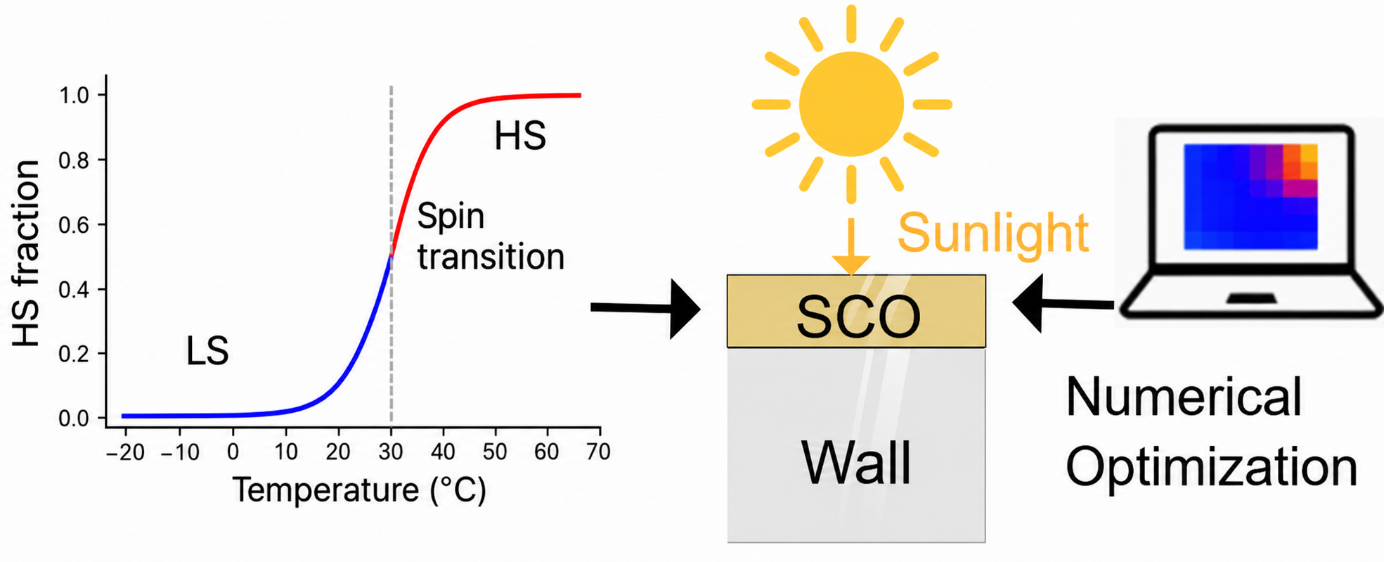
Schematic diagram of the thermoregulatory coating based on SCO material. (Left) Spin-transition curve illustrating the conversion between the low-spin state (LS, associated with the ‘cold’ state) and the high-spin state (HS, associated with the ‘hot’ state). (Centre) Passive response of the SCO layer under solar radiation: the latent heat associated with the transition limits the overheating of the building by reducing the heat flux through the wall. (Right) Numerical optimisation of structural (thickness) and electronic (ligand field) parameters to maximise thermal performance.
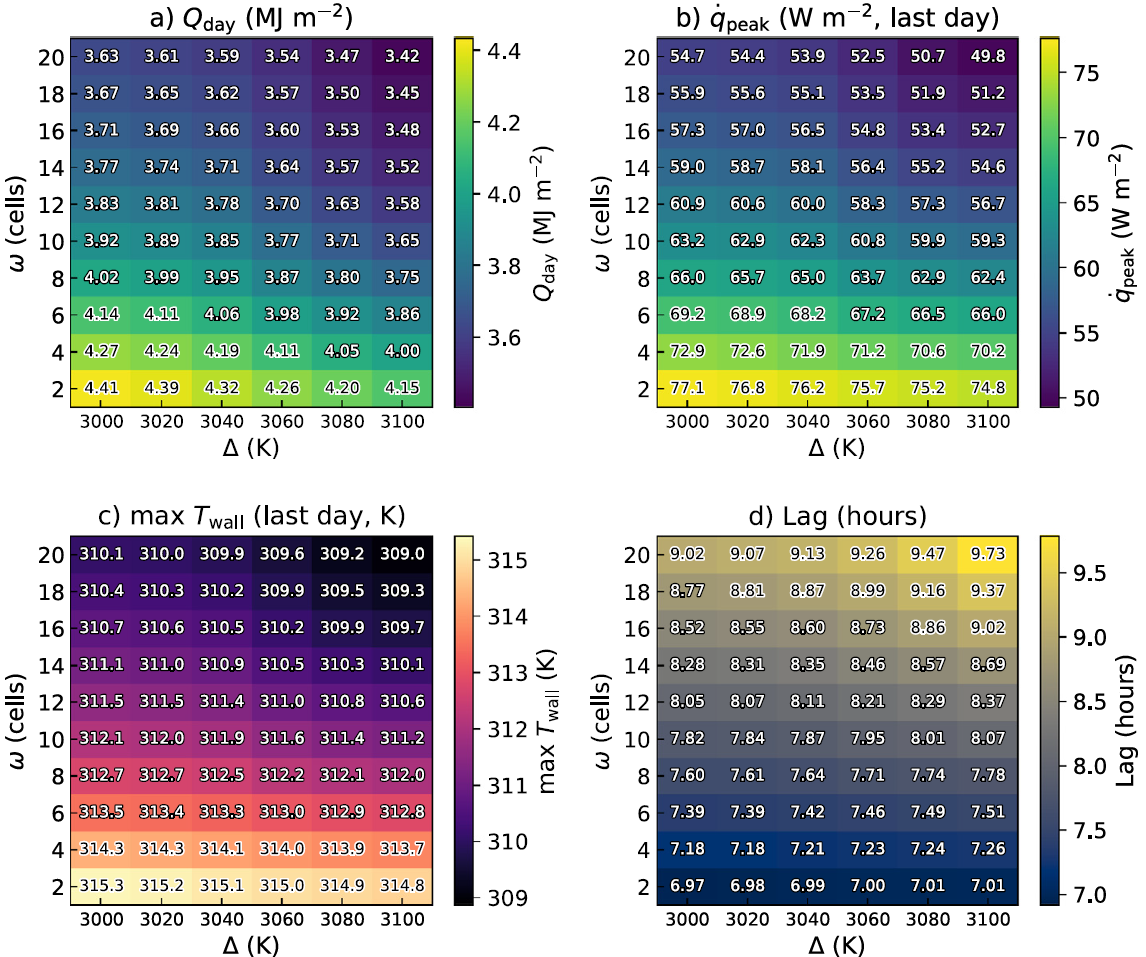
Thermal performance maps of a spin-transition coating as a function of layer thickness (ω) and ligand field strength (Δ), which controls the transition temperature. (a) Total thermal load transmitted into the building over the course of a day. (b) Maximum heat flux entering the building during the day. (c) Maximum temperature reached by the internal wall. (d) Time lag (in hours) between the peak of solar radiation and the peak of heat penetrating into the building.
Reference
A. Slimani, K. Boukheddaden,
“Numerical optimization of the physical properties of thermochromic layers based on spin transition materials for cold coating applications”,
Materials & Design 263, 115514 (2026).