




You are here : GEMACENResearch teamsAxis 3 - Quantum nanophotonics
- Updated on November 9, 2026
- PDF version
Photophysics of halide perovskites
Metal-halide perovskites are semiconductors processed from solution at low cost, which now rival the best inorganic semiconductors in solar cells, light-emitting devices and detectors. They are attracting growing interest for quantum technologies. Their performance relies on unusual properties: strong absorption, a high tolerance to defects and a soft, polar crystal lattice strongly coupled to electronic excitations. Their structural diversity, from 3D frameworks to 2D layered and 1D chain compounds, and the possibility of inserting functional or chiral organic cations, also make them a vast family of hybrid materials whose properties remain largely unexplored.
We study the fundamental photophysics of these materials: the nature of photoexcitations (free carriers, excitons, self-trapped excitons), their interaction with defects and with the crystal lattice, energy and charge transfer at organic–inorganic interfaces, and their spin properties. We combine materials engineering, carried out with chemist partners, with advanced optical spectroscopy from room temperature down to 4 K and from the macroscopic scale down to individual emitters. To access intrinsic properties, we focus on high-quality single crystals and exfoliated flakes.
- Excitons and defect states in halide perovskite single crystals
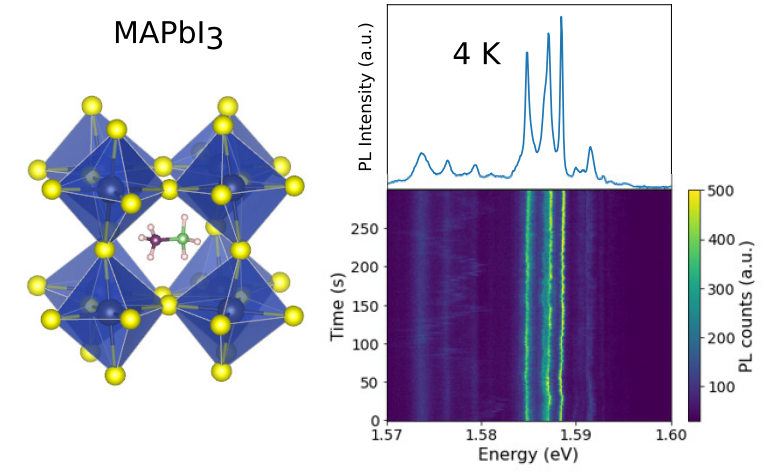
Fig. 1: (a) Crystal structure of CH3NH3PbI3. (b) Photoluminescence spectrum at 4 K showing ultra-sharp defect lines (top) and their evolution over 300 s (bottom); the lines fluctuate in synchrony [2].
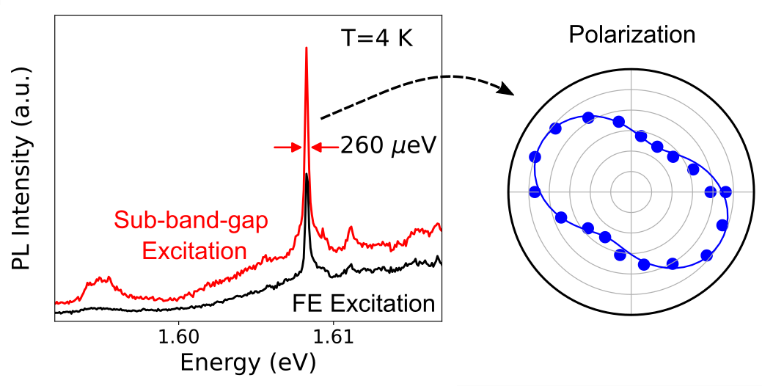
Fig. 2: Ultra-sharp defect emission line (260 µeV linewidth) at 4 K, under sub-band-gap excitation (red) and free-exciton (FE) excitation (black). Right: polar plot of its intensity versus polarization angle, showing a strongly linearly polarized emission [1].
- Low-dimensional hybrid perovskites
In 2D layered perovskites, excitons are confined in a natural multi-quantum-well structure (Fig. 3a), which gives strong excitonic effects at room temperature. We studied their recombination dynamics and exciton–exciton annihilation (Fig. 3b) [6]. Strong exciton–phonon coupling can also localize excitons on lattice distortions: in the 2D lead-bromide perovskite (C6H11NH3)2PbBr4, self-trapped excitons give a broadband white-light emission [10].
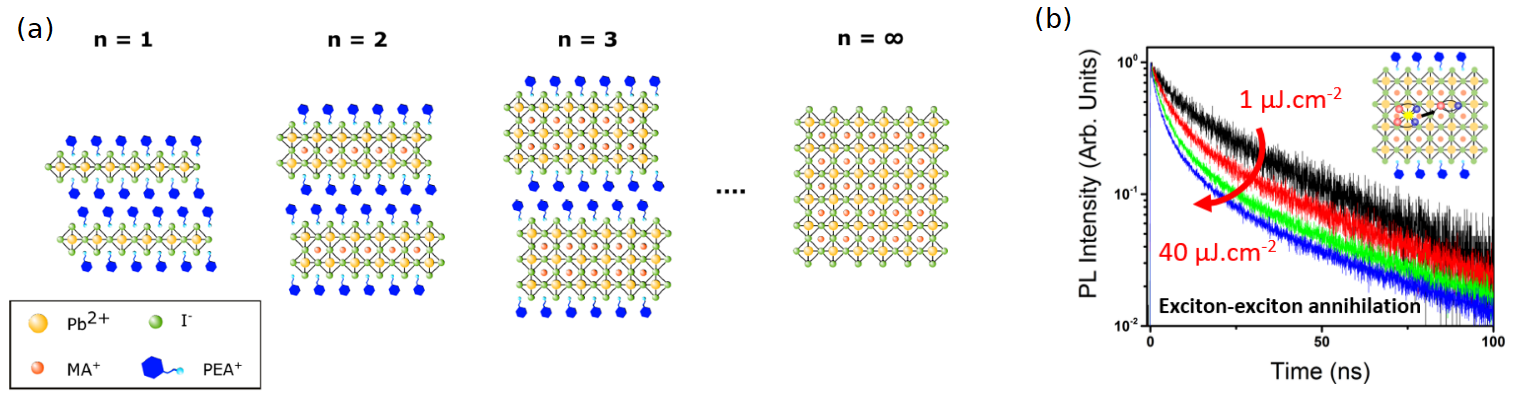
Fig. 3: (a) Ruddlesden–Popper layered perovskites (PEA)2(MA)n−1PbnI3n+1, from n = 1 (2D) to n = ∞ (3D CH3NH3PbI3); PEA = phenethylammonium, MA = methylammonium. (b) Photoluminescence decay of a 2D perovskite at room temperature for excitation fluences from 1 to 40 µJ cm−2; the faster decay at high fluence is the signature of exciton–exciton annihilation [6].
- Functional organic cations and organic–inorganic interfaces
In hybrid perovskites, the organic cation is not only a structural spacer: its choice can give the material a new function. Replacing the usually inert spacer with an optically active chromophore creates new coupling channels between the organic and inorganic sublattices. With tetrazine spacers, we showed that energy transfer and type-II band alignment strongly quench the perovskite exciton emission [5].
Chiral ammonium cations, in turn, template 1D lead-bromide chains whose spacing depends on the cation size. These compounds show broadband self-trapped-exciton emission with strong linear polarization at room temperature, promising for polarized light sources and chiral optoelectronics [4]. Together, these works provide a frame to design hybrids whose organic part is chosen for a target function.
Experimental tools
- Steady-state and time-resolved micro-photoluminescence, 4–300 K
Photoluminescence excitation and optical absorption spectroscopy
Polarization- and angle-resolved photoluminescence
Photon-correlation measurements
Magneto-photoluminescence up to 9 T, 4–300 K
Selected publications
"Strongly Polarized Emission and Sub-Band-Gap Excitation of Ultrasharp Defect Emitters in MAPbI3 Single Crystals"
J. Phys. Chem. Lett. (2026)
T. H. T. Nguyen, J. M. Urban, A. Delteil, G. Trippé-Allard, E. Deleporte, J. Even, S. Buil, J.-P. Hermier, D. Garrot,
"Collective Spectral Diffusion of Defect Luminescence in CH3NH3PbI3 Halide Perovskites"
J. Phys. Chem. Lett. 17, 5652 (2026) – [HAL]
J. M. Urban, T. T. Huyen Nguyen, G. Chehade, A. Delteil, G. Trippé-Allard, G. Delport, E. Deleporte, J.-P. Hermier, D. Garrot,
"Discrete Donor-Acceptor Pair Transitions in CH3NH3PbI3 Perovskite Single Crystals",
PSS Rapid Research Letters (2023) – [HAL]
J. Urban, A. Jouaiti, N. Gruber, G. Delport, G. Trippé-Allard, J.-F. Guillemoles, E. Deleporte, S. Ferlay, D. Garrot,
"Using chiral ammonium cations to modulate the structure of 1D hybrid lead bromide perovskites for linearly polarized broadband light emission at room temperature",
J. Mater. Chem. C. 10, 12436 (2022) – [HAL]
F. Lédée, P. Audebert, G. Trippé-Allard, L. Galmiche, D. Garrot, J. Marrot, J.-S. Lauret, E. Deleporte, C. Katan, J. Even, C. Quarti,
"Tetrazine molecules as efficient electronic diversion channel in 2D organic-inorganic perovskites",
Materials Horizons 8, 1547 (2021) – [HAL]
G. Delport, G. Chehade, F. Lédée, H. Diab, C. Milesi-Brault, G. Trippé-Allard, J. Even, J.-S. Lauret, E. Deleporte, D. Garrot,
"Exciton-exciton annihilation in two-dimensional halide perovskites at room temperature"
J. Phys. Chem. Lett. 10, 5153–5159 (2019) – [HAL]
H. Diab, C. Arnold, F. Lédée, G. Trippé-Allard, G. Delport, C. Vilar, F. Bretenaker, J. Barjon, J.S. Lauret, E. Deleporte, D. Garrot,
"Impact of Reabsorption on the Emission Spectra and Recombination Dynamics of Hybrid Perovskite Single Crystals"
J. Phys. Chem. Lett. 8, 2977--2983 (2017) – [HAL]
F. Lédée, G. Trippé-Allard, H. Diab, P. Audebert, D. Garrot, J.S. Lauret, E. Deleporte,
"Fast growth of monocrystalline thin films of 2D layered hybrid perovskite"
CrystEngComm 19(19), 208-215 (2017) – [HAL]
H. Diab, C. Arnold, F. Lédée, G. Trippé-Allard, G. Delport, C. Vilar, F. Bretenaker, J. Barjon, J.S. Lauret, E. Deleporte, D. Garrot,
"Impact of Reabsorption on the Emission Spectra and Recombination Dynamics of Hybrid Perovskite Single Crystals"
J. Phys. Chem. Lett. 7, 2977--2983 (2017) – [HAL]
A. Yangui, D. Garrot, J. S. Lauret, A. Lusson, G. Bouchez, E. Deleporte, S. Pillet, E. E. Bendeif, M. Castro, S. Triki, Y. Abid, K. Boukheddaden,
"Optical Investigation of Broadband White-Light Emission in Self-Assembled Organic-Inorganic Perovskite (C6H11NH3)(2)PbBr4,"
J. Phys. Chem. C 119(41), 23638–23647 (2015) – [HAL]
Contact
Axis 3 – Quantum nanophotonics
Research topics
Members
Permanent staff:
Stéphanie Buil, PR (vice-director of GEMaC)
Jean-Pierre Hermier, PR (head of the team)
Xavier Quélin, PR
Damien Garrot, MCF
Aymeric Delteil, CR
Non permanent staff:
Hien Phan, PhD student
Helmi Fartas, PhD student
Andrés Núñez Marcos, PhD student
Ayoub Gualous, PhD student
Tien Thanh Nguyen, PhD student
Shayna Nepaul, PhD student
Former group members